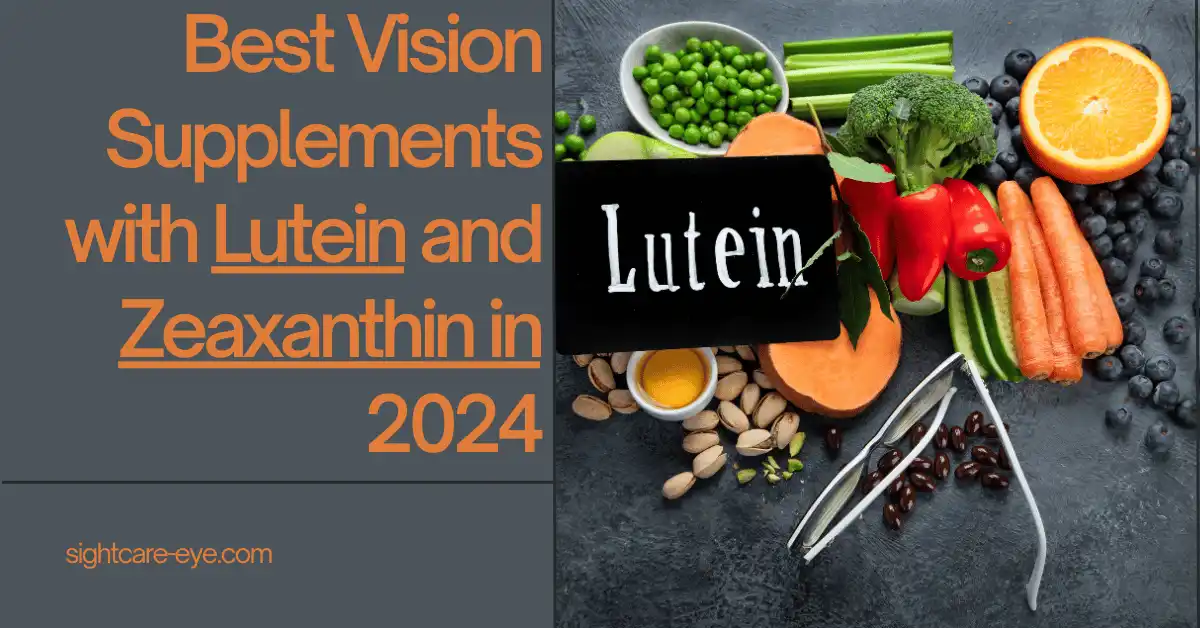
Lutein and zeaxanthin are carotenoids present in the eye and in foods. A daily combination of 10 mg lutein and 2 mg zeaxanthin appears in the studied AREDS2 formula for selected people with AMD; that does not prove general vision restoration in everyone.
Key concepts in view
These supporting visuals help summarize the main ideas without replacing the detailed guide below.

What are lutein and zeaxanthin?
Lutein and zeaxanthin are pigments known as carotenoids, found in vegetables and concentrated in parts of the retina. Their biological roles make them interesting to researchers, but it is important to separate plausible nutrition biology from demonstrated benefits of a supplement in humans.
They are often advertised as a universal fix for digital eye strain, blurry eyesight or age-related vision decline. Those claims are broader than the established evidence.
Why the AREDS2 numbers matter
The National Eye Institute’s AREDS2 formulation includes 10 mg of lutein and 2 mg of zeaxanthin per daily formula together with specified amounts of vitamins C and E, zinc and copper. Studies show benefit in some people with intermediate AMD and certain people with later disease in one eye.
A capsule containing only lutein and zeaxanthin is not the full AREDS2 formula. It may be a reasonable dietary supplement for some consumers, but it should not be described as clinically equivalent to AREDS2 for AMD.
Comparing different product labels
| Label question | Why it matters |
|---|---|
| Exact milligrams of lutein? | Lets you compare with clinical formulas and avoid vague claims |
| Exact milligrams of zeaxanthin? | The pair may have different listed amounts |
| Serving size per day? | Two capsules may be required for the advertised dose |
| Other nutrients included? | Added zinc, vitamin E or beta-carotene changes the formula and safety discussion |
| Independent quality data? | Identifiable product testing is more informative than generic “premium quality” badges |
| Price per day? | A large bottle is not always better value |
Use the label-reading guide before comparing actual brands. A formula does not become the “best” because it has the highest milligrams or the most ingredients.
Can food provide these nutrients?
Leafy greens and other colorful foods contribute carotenoids to a varied diet. Healthy food patterns have broad benefits beyond individual nutrients. However, the AREDS2 treatment formula for the relevant AMD stages involves specified supplemental amounts and is not interchangeable with an ordinary meal plan.
For everyday food ideas see foods that support eye health.
Who should talk to an eye-care professional?
People with diagnosed AMD should discuss whether an AREDS2 formula is appropriate. Anyone with chronic eye disease, other medications, pregnancy-related concerns, or a reason to avoid high doses should seek individualized guidance. If your eyes have become blurry, determine the cause rather than assuming a carotenoid shortage.
Evidence map: which outcomes are established?
Claims about “eye support” can refer to different outcomes. A change in macular pigment measured by a device is not the same outcome as preventing disease, improving a person’s ability to read an eye chart, or reducing their need for glasses.
| Claim you may see | What you can reasonably conclude |
|---|---|
| “Contains carotenoids found in the macula” | A statement about where these nutrients occur; not proof that a product treats a disease |
| “Supports macular pigment” | Some research evaluates pigment measures; the result should not be translated automatically into restored vision |
| “Based on AREDS2” | Check whether the entire six-nutrient daily formula and relevant AMD context are present |
| “Improves blurry vision” | Blurred vision can arise from refractive error, dry eye, cataracts, retinal disease or other conditions; do not assume supplements address the cause |
| “Clinically proven” | Ask for a human trial on the same finished formula, patient group, dose and outcome |
Practical interpretation: For a consumer without diagnosed AMD, there is not sufficient evidence to promise sharper vision from a routine lutein-zeaxanthin capsule. For certain stages of AMD, the whole AREDS2 formula has evidence that does not transfer automatically to a stand-alone carotenoid product. Read the NEI’s eligibility guidance.
A worked label-comparison example
Imagine two hypothetical labels. These are illustrations, not actual products or purchase recommendations:
| Example A | Example B | |
|---|---|---|
| Label headline | “Lutein complex” | “Lutein + zeaxanthin” |
| Daily serving | 1 capsule | 2 capsules |
| Lutein amount disclosed | 10 mg | 10 mg |
| Zeaxanthin amount disclosed | Included in a proprietary blend; exact dose not specified | 2 mg |
| Can you verify the daily carotenoid ratio? | No | Yes |
| Can you call either the full AREDS2 formula? | No | No |
This example shows why label transparency matters. It also illustrates a limitation of using “10:2” as a shopping rule: matching the carotenoid ratio alone does not make a product equivalent to the trial formula.
Questions worth answering before buying
Should someone with intermediate AMD buy lutein alone? Do not substitute a simple carotenoid capsule for an AREDS2 formula recommended by their eye-care clinician without discussing the change. The research finding concerns the studied combination and eligible patient groups.
Can the ingredients eliminate the need for prescription glasses? There is no reliable basis for claiming that lutein or zeaxanthin changes refractive errors such as nearsightedness or astigmatism.
Can you take several “eye health” products together? Potentially overlapping ingredients may increase total exposure to vitamin E, zinc, beta-carotene or other nutrients. Add the full daily amounts across all bottles and discuss relevant medicines or health conditions with a clinician.
What if the product has extra ingredients such as bilberry or saffron? Extra ingredients do not make the product automatically better. Look for individual ingredient doses and relevant human outcomes. If evidence for the finished formula is unavailable, say so.
Sources
- National Eye Institute — AREDS2 supplements
- National Eye Institute — AREDS and AREDS2 clinical trials
This guide is based on published research and public health sources. We have not personally tested supplements or provided individualized medical advice. Read our evaluation process.
Check the evidence, then the label.
Use our label reference tool to compare stated daily amounts with the NEI AREDS2 study formula. A dose match does not establish suitability or product quality.