
Eye supplements are not automatically harmless because they are sold without prescriptions. High-dose AREDS2 formulations are meant for particular AMD circumstances, while ingredients such as vitamin E, zinc and beta-carotene raise important questions about medicines, tolerability and smoking history. Ask your clinician to review a complete label and your other medicines.
Key concepts in view
These supporting visuals help summarize the main ideas without replacing the detailed guide below.
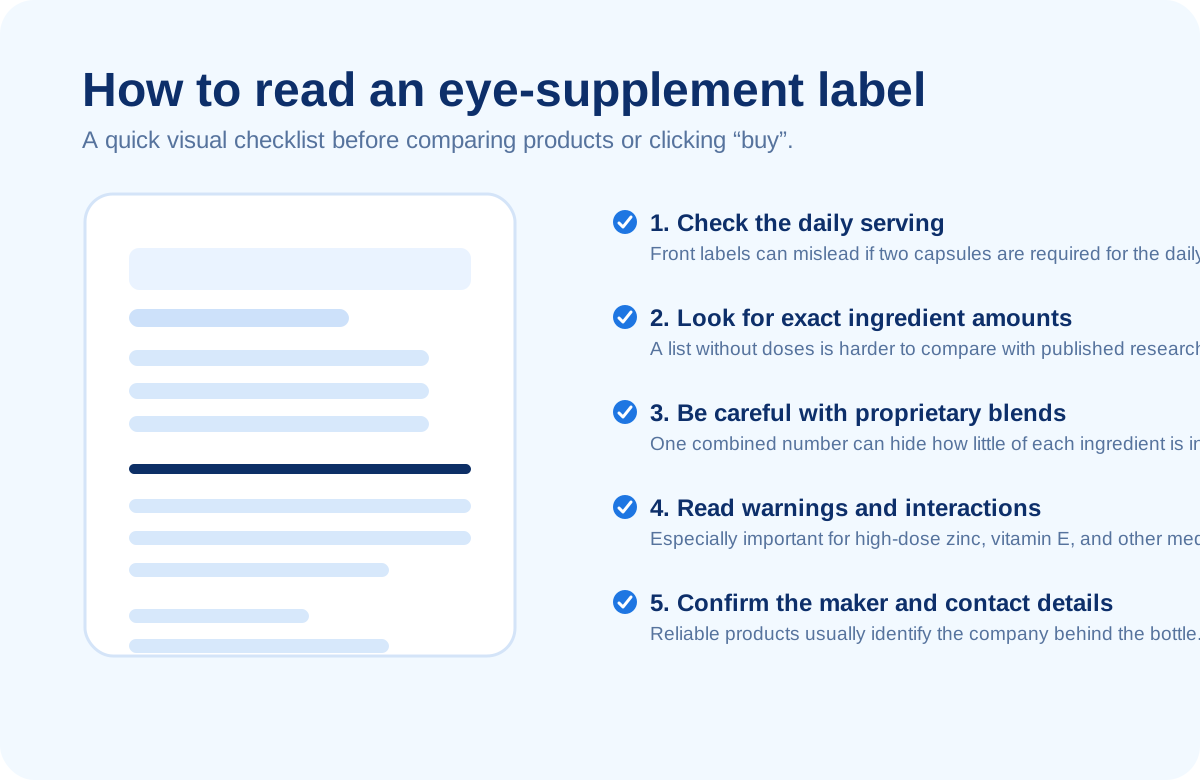
Why eye supplement safety depends on the formula
An eye supplement may be a low-dose multivitamin, a lutein-and-zeaxanthin capsule, or a high-dose formulation resembling the National Eye Institute’s AREDS2 formula. Those categories are not interchangeable. Amounts, combinations, diagnoses, and concurrent medicines matter more than a reassuring product name.
The AREDS and AREDS2 studies involved specific groups of people with age-related macular degeneration (AMD). The study results do not mean that every older adult should take high doses of those ingredients. An ophthalmologist can advise if your stage of AMD makes the formulation relevant.
Ingredient-specific issues worth checking
| Ingredient or ingredient group | Safety consideration | What to do before buying |
|---|---|---|
| Vitamin E in high-dose formulas | The NIH Office of Dietary Supplements describes potential interactions with anticoagulant and antiplatelet medicines; high doses may affect bleeding risk. | Discuss the dose and your medicines, including any prescription or nonprescription blood thinners. |
| Zinc | Long-term high intake can interfere with copper absorption; nausea and stomach upset can occur. The NIH zinc fact sheet describes these effects and medication interactions. | Check total daily intake, especially if taking a multivitamin or other zinc product. |
| Copper | Added to the studied formula in part to address zinc-related copper depletion; it is not a reason to take extra copper independently. | Compare the entire formulation rather than adding single nutrients on your own. |
| Beta-carotene | The older AREDS formulation included beta-carotene; studies found increased lung-cancer risk in smokers and former smokers. | Check for beta-carotene and discuss smoking history with your eye-care professional. |
| Botanical blends | Proprietary mixtures may not disclose the dose of each component; safety information is often limited. | Ask for a complete label, potential allergy information and credible product evidence. |
The amounts in AREDS2 reflect a clinical-study formulation, not a safe or useful daily routine for every healthy adult. Some clinicians may recommend alternate zinc formulations; do not use a calculator to override that professional advice.
What about blood thinners or aspirin?
The potential interaction between supplemental vitamin E and anticoagulant or antiplatelet medicines deserves special attention. The evidence does not mean that every person using those medicines will experience bleeding, but it does make a medication review important. Do not stop or change prescribed medicines because of a supplement advertisement or this article.
If a retailer offers only a summary of ingredients, obtain the full Supplement Facts panel before purchase. A label must be evaluated alongside your medical history, medication list and other supplements.
What does “natural” tell you about safety?
Very little by itself. Being plant-derived does not prove a product is effective, free from contamination, or suitable with medications. Evidence supporting a single nutrient in a specific population does not validate every commercial blend that contains that nutrient. Read our eye supplement label guide for an exact checklist.
Five questions to ask your pharmacist or eye-care clinician
- Is this formula relevant to my diagnosed eye condition, or am I buying it for a problem that requires an eye exam?
- Does its daily serving contain high doses of vitamin E, zinc, beta-carotene or any ingredient that conflicts with my medicines?
- Is there a reason to prefer a standard multivitamin, no supplement, or a specific studied formulation?
- Do I already receive these ingredients in other products, potentially creating duplicate doses?
- If my symptoms are changing, what examination or follow-up should take priority over shopping?
Compare ingredients and cost carefully
Use the AREDS2 label reference checker to compare stated amounts, not to diagnose disease or determine suitability. Our cost-per-day calculator helps compare prices only after the formulation has been assessed for your needs.
Sources and limitations
- National Eye Institute — AREDS2 Supplements for AMD
- NEI — AREDS/AREDS2 frequently asked questions, formulations, risks
- NIH Office of Dietary Supplements — Vitamin E
- NIH Office of Dietary Supplements — Zinc
This guide describes published research and safety considerations; it is not a personal medicine-interaction screen. Labels change, and no products were personally tested for this article.
This guide is based on published research and public health sources. We have not personally tested supplements or provided individualized medical advice. Read our evaluation process.
Check the evidence, then the label.
Use our label reference tool to compare stated daily amounts with the NEI AREDS2 study formula. A dose match does not establish suitability or product quality.