There is no well-established over-the-counter supplement that reliably improves night vision in otherwise healthy adults. Correcting a diagnosed vitamin A deficiency may help deficiency-related night blindness; AREDS2 is for selected AMD patients, not a proven night-driving booster.
Key concepts in view
These supporting visuals help summarize the main ideas without replacing the detailed guide below.
The key question: deficiency, disease or marketing promise?
Many supplement pages claim that antioxidants “restore night vision” or that taking a botanical blend makes the retina adapt more quickly to darkness. Those statements require direct human evidence—not just a plausible mechanism or an ingredient’s presence in the eye.
To evaluate an advertised formula, first distinguish a nutrient required for normal vision from a pill proven to improve normal vision beyond baseline. The distinction is fundamental and is often omitted from promotional content.
Ingredient comparison
| Ingredient or formula | What is reasonably supported | What is not established |
|---|---|---|
| Vitamin A | Needed for normal vision; treatment of medically diagnosed deficiency may help deficiency-related night blindness | Better night vision from extra vitamin A in a person with adequate intake |
| Bilberry extract | Contains anthocyanins of research interest | Consistent improvements in night vision in healthy people |
| Lutein + zeaxanthin | Studied as carotenoids, including as components of AREDS2 | A reliable treatment for headlight glare or poor nighttime driving |
| AREDS2 formula | Can reduce progression risk for specific AMD groups, following clinician advice | Reversing AMD, fixing cataracts or generally enhancing night vision |
| Mixed proprietary herbal blend | Depends on each disclosed ingredient and human evidence for the same doses | Effectiveness merely because the formula has many botanicals |
The NCCIH bilberry review notes that the most rigorous studies have not found better night vision in healthy adults. The National Eye Institute’s AREDS2 findings concern AMD progression, a separate outcome.
Why lab studies are not enough
An ingredient might affect oxidative markers in cells, influence retinal biology in animals or be present naturally in healthy eyes. These observations can generate useful hypotheses, but they cannot establish that capsules make a driver see road hazards sooner.
Look for clinical trials that measure the outcome being promised—for example, nighttime acuity, contrast sensitivity under low illumination or dark-adaptation performance—in an appropriate human group. Check whether results were replicated and whether the tested doses match the label.
Important safety questions
- Vitamin A: Some forms and doses can cause toxicity, particularly with long-term excessive intake. Check other supplements and medications before adding more.
- High-dose mineral formulas: AREDS2 contains substantially more zinc than an ordinary multivitamin. Discuss suitability and possible adverse effects with your eye-care team.
- Herbs and extracts: “Natural” does not guarantee safety. Relevant drug interactions or product-quality issues may apply.
- Proprietary blends: Hidden per-ingredient amounts make evidence matching difficult.
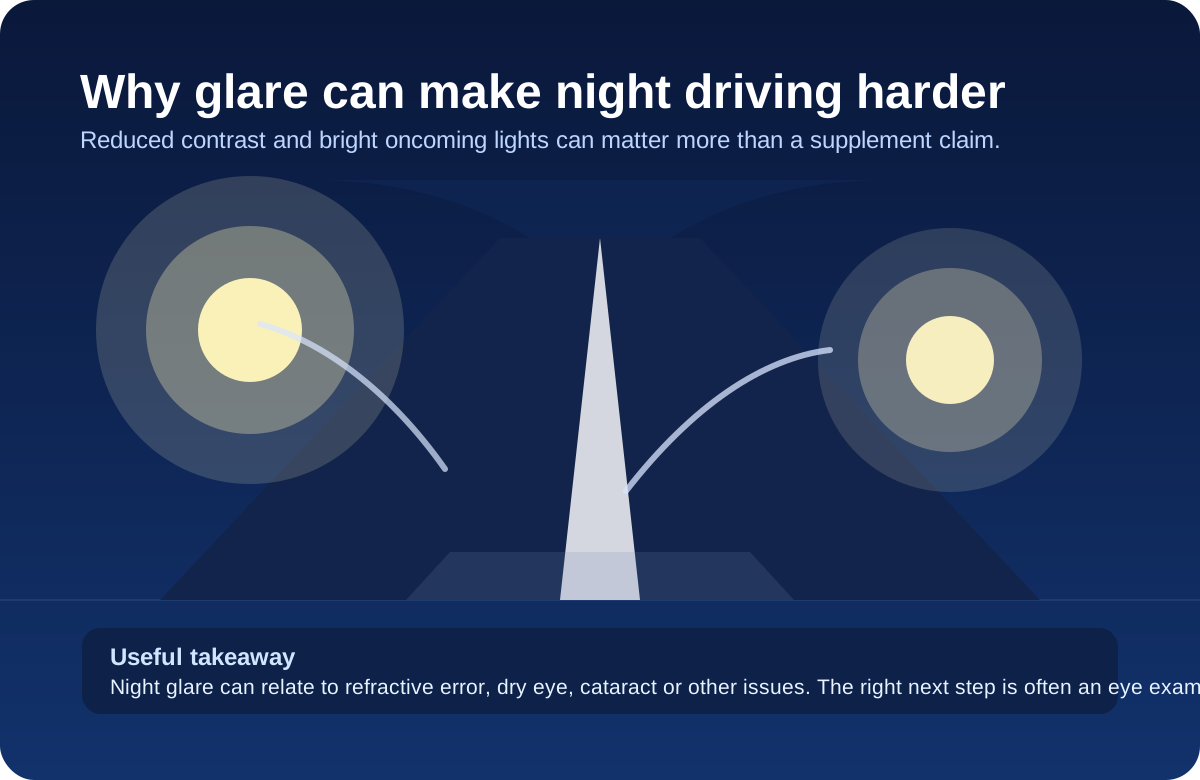
Avoid supplement shopping as a substitute for evaluation when night vision worsens. Cataracts, prescription changes, and other eye conditions can change contrast or glare and need cause-specific care.
How to compare two night-vision products
When a page announces “top seven” without clear methods, ask what ranking evidence actually supports its order. A useful comparison would show:
- The exact total daily dose of each ingredient.
- Human studies with relevant night-vision outcomes, if any.
- An honest evidence grade and clear negative findings.
- Manufacturer identity, available quality documentation and any adverse-event cautions.
- Total cost per day, refund details and ongoing subscription terms.
Our supplement-label checklist and price-per-day calculator are designed to help with those practical questions. Until two products are verified, we do not assign star ratings or a fabricated winner.
Better first steps than purchasing a supplement
If the problem is poor night vision, begin with the practical night-vision guide. Changes in vision deserve an eye examination, particularly if driving feels unsafe. Supplements are most useful when there is an evidence-supported indication, not a broad promise to “rebuild eyesight.”
Sources
- NCCIH — Bilberry research and safety
- National Eye Institute — AREDS2 clinical findings
- National Eye Institute — AMD supplement eligibility
If the main problem is glare when driving
A supplement comparison is not the right first decision when headlights or road signs have recently become harder to see. Start with a professional eye examination and the practical guidance in our night-driving and glare guide. Your priority is safe visibility and finding the underlying cause.
This guide is based on published research and public health sources. We have not personally tested supplements or provided individualized medical advice. Read our evaluation process.
Check the evidence, then the label.
Use our label reference tool to compare stated daily amounts with the NEI AREDS2 study formula. A dose match does not establish suitability or product quality.