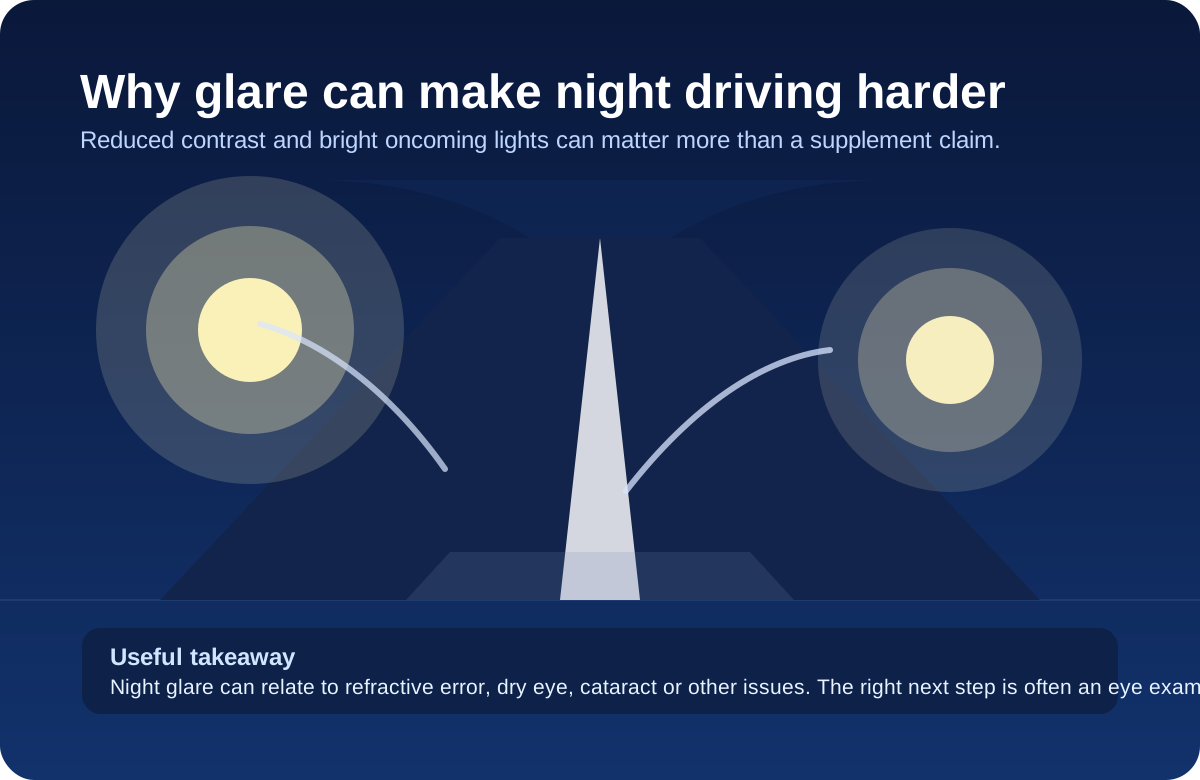
Difficulties with headlights, halos or road signs at night are reasons to check eyesight and eye health—not reasons to assume a vitamin will solve the problem. Cataracts, uncorrected prescriptions and other eye conditions can affect driving. Avoid driving when visibility is unsafe and seek an eye examination for persistent or worsening symptoms.
Key concepts in view
These supporting visuals help summarize the main ideas without replacing the detailed guide below.
Why is driving after dark harder?
Night driving combines lower illumination with rapidly changing sources of light, reflections and contrast. Some people first notice a problem when oncoming headlights appear unusually dazzling, traffic signs become difficult to read, or halos appear around lights. These symptoms are worth describing to an optometrist or ophthalmologist rather than treating them as an ordinary part of aging.
No single symptom identifies the cause. A vision examination helps distinguish a current glasses prescription from cataracts and other problems requiring a different approach.
How different symptoms can guide your conversation with an eye-care professional
| What you notice | Possible considerations | Helpful next step |
|---|---|---|
| Headlights look unusually bright or scattered | Cataract-related light scattering, ocular surface problems or uncorrected refractive error | Arrange an eye exam and describe when glare occurs |
| Road signs are blurry at a distance | Glasses prescription may need review; other causes also possible | Ask for distance acuity and refraction assessment |
| Halos around streetlights | Multiple possible causes, including cataract or corneal issues | Ask your eye-care professional to assess new or changing halos |
| Night driving suddenly becomes much harder | Could indicate an acute eye or medical issue, depending on other symptoms | Seek prompt medical assessment; urgent care for sudden vision changes |
| Vision is acceptable in daylight but poor in dim conditions | Reduced contrast sensitivity or dark adaptation may be involved | Discuss night-vision concerns specifically during examination |
This table is a conversation aid, not a self-diagnosis tool. Sudden vision loss, eye pain or new neurologic symptoms merit urgent medical assessment.
Why cataracts matter for glare
A cataract clouds the eye’s lens. It can make lights appear hazy or glaring, especially at night. The American Academy of Ophthalmology advises limiting night driving when halos or glare are problematic, and discussing appropriate treatment with an eye doctor. Cataracts cannot be removed by taking a nutritional supplement; surgery is the established treatment when clinically indicated.
You can read more in our cataracts and natural-remedy claims guide.
Practical steps that do not depend on buying supplements
- Update your eye exam. Explain your night-driving experience and whether it changes with the weather, a particular road or fatigue.
- Use the glasses prescribed for driving. Ensure the prescription is current, the lenses are clean and the frame fits correctly.
- Keep car windows and mirrors clean. Smudges and scratches can worsen apparent glare.
- Reduce unnecessary nighttime trips when visibility is poor, particularly while symptoms remain unexplained.
- Do not treat sunglasses as a night-driving solution. Dark lenses reduce available light and can worsen visibility.
- Get immediate help for sudden vision loss or severe new symptoms. Do not drive yourself for urgent evaluation.
These measures may improve practical conditions but cannot substitute for diagnosis and treatment of an underlying eye problem.
Will lutein, bilberry or vitamin A improve night driving?
Vitamin A is essential for normal visual function, and a true deficiency can cause night blindness. That does not mean high-dose vitamin A improves vision in everyone who has trouble driving after dark. Excess vitamin A can also cause harm.
For bilberry and other advertised “night vision boosters,” the evidence is not adequate to promise improved night-driving performance in otherwise healthy adults. See our broader examination of night vision supplements and improving night vision. High-dose AREDS2 supplements apply to certain stages of AMD; they are not an evidence-backed general night-driving fix.
Questions to bring to an eye appointment
Ask whether you need updated refraction testing, cataract assessment, a dilated eye examination, review of medicines that may affect vision, or further testing for glare or reduced contrast sensitivity. Mention whether the problem began suddenly, has progressed slowly, or occurs in just one eye.
The right goal is safe driving and an explanation for the symptom, not buying whichever supplement has the boldest nighttime-vision claims.
Sources and limitations
- American Academy of Ophthalmology — Cataract diagnosis and treatment
- National Eye Institute — Cataracts
- National Eye Institute — AREDS2 and eligibility
- NCCIH — Bilberry: usefulness and safety
This article summarizes public guidance and cannot determine fitness to drive or diagnose the cause of a specific visual symptom.
This guide is based on published research and public health sources. We have not personally tested supplements or provided individualized medical advice. Read our evaluation process.
Understand the cause, not just the claim.
Learn what may explain your symptoms and where research supports—or contradicts—popular advice. New or changing vision symptoms need professional assessment.