Many popular vision tricks may improve comfort or habits, but that is different from correcting refractive error, removing cataracts or treating retinal disease. Ask what a claim actually measures before believing the result.
Key concepts in view
These supporting visuals help summarize the main ideas without replacing the detailed guide below.
A better way to evaluate vision advice
A convincing video often shows one person saying a ritual changed their vision. But without a measured diagnosis, comparison group and explanation of other changes, it cannot demonstrate that the trick works. Three questions are especially useful: What is the claimed outcome? In which people? And what evidence directly measured it?
Myth 1: Eye exercises can eliminate the need for glasses
General eye movement exercises do not normally change the optics responsible for nearsightedness, farsightedness or astigmatism. The American Academy of Ophthalmology reports a lack of convincing evidence that such exercises improve uncorrected visual acuity. Certain professionally prescribed visual therapies for specific conditions are a separate topic.
Myth 2: Carrots will give you better-than-normal night vision
Carrots contain carotenoids that the body can convert to vitamin A. Vitamin A deficiency can impair vision, including low-light function. But eating extra carrots does not give a person with adequate nutrition superhuman night vision.
Myth 3: A supplement can remove cataracts
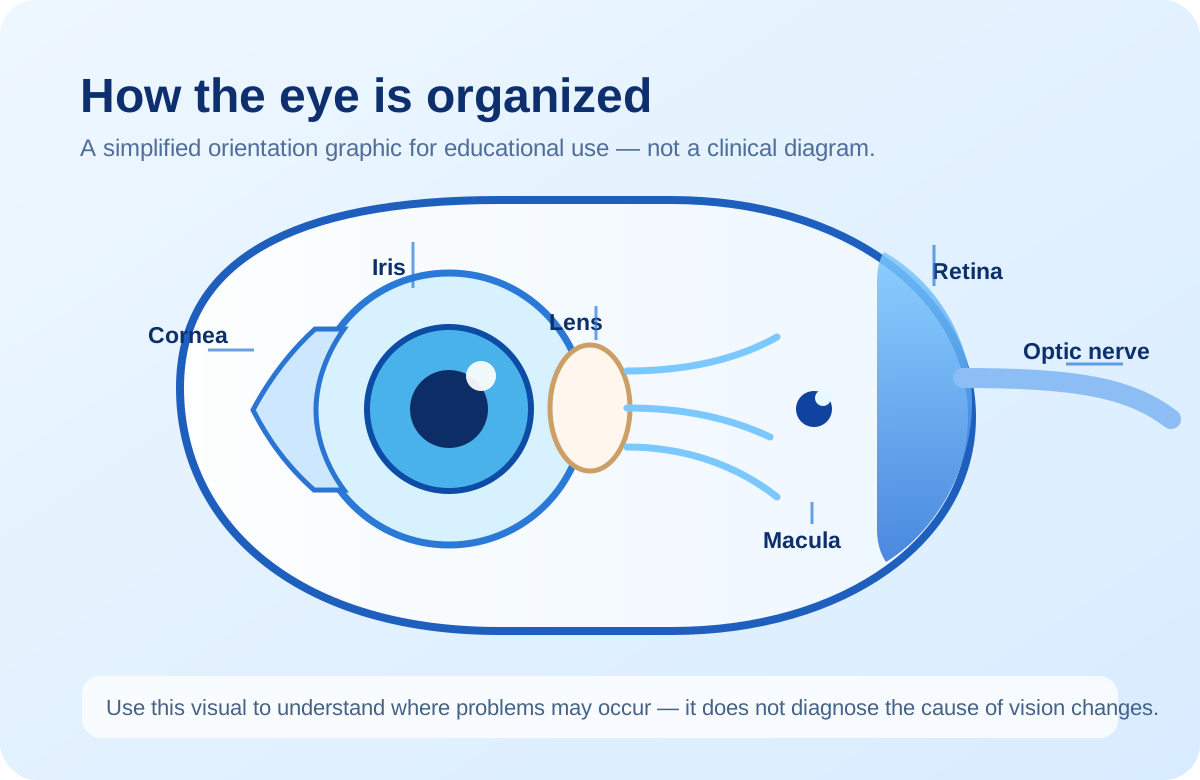
Cataracts involve clouding of the eye’s natural lens. According to the National Eye Institute, surgery is the way to remove an existing cataract. No supplement has demonstrated an ability to dissolve an established cataract. See our detailed cataract guide.
Myth 4: A seven-second ritual restores 20/20 vision
An appealing number and simple routine do not provide scientific evidence. Vision quality depends on the underlying cause. A ritual cannot replace a refraction, cataract assessment or treatment for retinal disease.
Myth 5: More supplements automatically mean stronger eyesight
The strongest large trial evidence around eye supplements involves specific AREDS2 ingredients for particular AMD groups, not a general dose-response rule for everybody. High-dose nutrients can also create risks. Read our eye-vitamin evidence guide.
Practical habits that do make sense
Comfort and long-term health habits can be worthwhile without claiming they cure disease: regular breaks during near work, appropriate lighting, routine eye examinations and managing underlying medical conditions all have sensible roles. Success should be judged by a realistic outcome, not an exaggerated promise.
Myth 6: Blue-light glasses are necessary to protect your retina from screens
The American Academy of Ophthalmology explains that normal screen exposure has not been shown to cause retinal damage in humans, and that special blue-light filtering glasses are not routinely necessary for computer use. Digital discomfort is often related to prolonged near work, reduced blinking, dry eye, screen brightness and glare rather than damage caused by the blue light itself.
Instead of buying an unneeded coating, first check your prescription, lighting and ergonomics. People who need dedicated prescription computer lenses for intermediate viewing distance should discuss options with their optician; prescription task glasses are a different product from generic blue-blocking lenses.
See the Academy’s October 2026 digital-device advice for a current summary.
Myth 7: “Doctor-developed” means clinical proof
A genuine health professional can participate in developing a product without the finished product having been independently tested for the advertised outcome. Check whether the claimed trial included the actual product, the stated dose, a relevant patient population, and meaningful outcomes. If a creator’s credentials cannot be verified, the claim deserves extra scrutiny.
A claims checklist to use before sharing a vision tip
Before you forward a video or buy a supplement, ask:
- Is the claim about reducing discomfort, correcting blur or treating a disease? Those are different endpoints.
- Does the source offer direct human evidence for that outcome?
- Are the author, study, formula and actual tested dose identifiable?
- Does the advice discourage needed examination or established treatment?
- Is the person making the claim also selling the advertised solution?
When evidence is weak, an honest article should say so rather than asserting that the trick “definitely works” or “definitely cannot ever work” in every imaginable context.
Sources
- American Academy of Ophthalmology — Eye exercise evidence
- National Eye Institute — Cataract surgery
- National Eye Institute — AREDS2 major findings
This guide is based on published research and public health sources. We have not personally tested supplements or provided individualized medical advice. Read our evaluation process.
Understand the cause, not just the claim.
Learn what may explain your symptoms and where research supports—or contradicts—popular advice. New or changing vision symptoms need professional assessment.