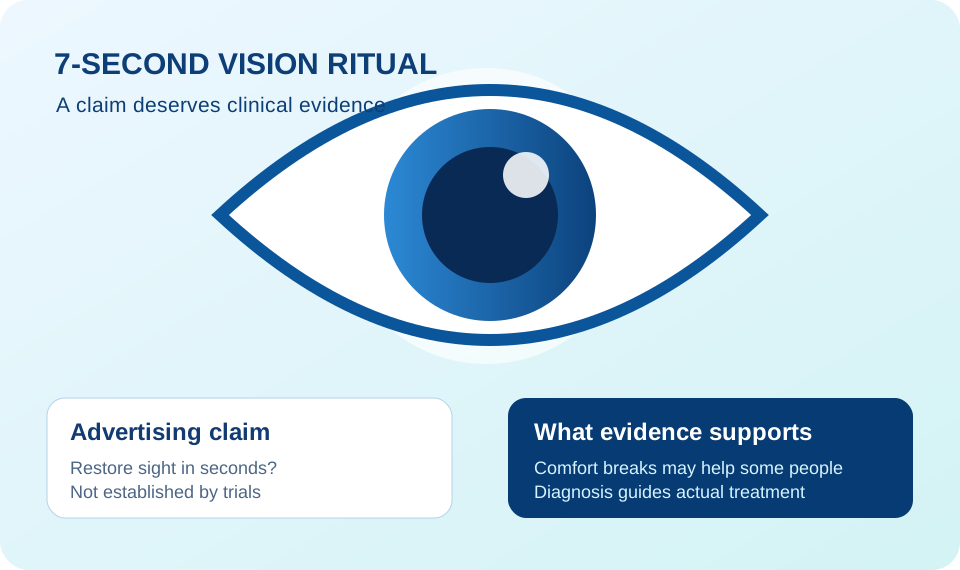
There is no reliable clinical evidence that a seven-second routine or eye supplement can restore 20/20 vision, regenerate damaged eye tissue or replace glasses and treatment. Short breaks may improve comfort, but visual acuity and eye disease require different evidence and care.
Quick answer: does the seven-second vision ritual really work?
No convincing clinical evidence shows that a seven-second vision ritual restores eyesight or repairs damaged eye tissue. The phrase has appeared in promotions for eye supplements, including versions tied to SightCare and VisiSoothe. Some descriptions depict a brief exercise or relaxation practice; others describe taking a supplement in a few seconds. These are different activities, and neither should be confused with a tested treatment for blurry vision, cataracts or retinal disease.
Looking away from a screen, blinking and taking regular breaks can help some people feel more comfortable. Feeling less eye strain is not the same as achieving 20/20 vision or reversing an eye condition. See our detailed guide to what restoring 20/20 vision actually means.
What is the “7-second vision ritual” supposed to be?
The phrase is a marketing label, not a standardized clinical protocol. Historical advertisements used variations of a short nightly ritual, a vision-activation switch, and nutritional support. An older article previously published at this address promoted a VisiSoothe “activation ritual,” described as swallowing a supplement with water, and claimed that stem cells could repair the eyes. That article did not establish clinical proof for those outcomes.
| Promotional framing | What a reader should know |
|---|---|
| “Do this in seven seconds” | A duration does not establish biological effectiveness. Verify exactly what is being performed. |
| “Restore perfect 20/20 vision” | A visual-acuity outcome requires standardized measurement and an appropriate clinical trial. |
| “Activate eye-repair stem cells” | Cell and laboratory research does not show that an oral supplement regenerates a person’s retina or lens. |
| “Avoid glasses or surgery” | Refractive error, cataracts and eye diseases have different causes and evidence-based treatments. |
| “Doctors don’t want you to know” | Secrecy and conspiracy language are not substitutes for independently published studies. |
Historical context: The US Food and Drug Administration included sightcare-eye.com among websites reviewed in August 2024 in an advisory letter about SightCare disease-treatment claims. This website has since been rebuilt as an independent educational publication, not an official product store. Our SightCare historical archive explains that change.
Do eye exercises improve vision?
For most people, exercises do not correct nearsightedness, farsightedness, astigmatism or age-related changes requiring reading glasses. The American Academy of Ophthalmology says evidence is insufficient that exercises improve uncorrected sharpness of vision. Its eye-exercise guidance distinguishes this from treatment for particular eye-coordination disorders.
There is an important exception to a blanket statement that all eye exercises are useless: professionally directed exercises can help certain people with convergence insufficiency, where the eyes struggle to work together at near distances. That is a specific diagnosed problem, not evidence for a generic seven-second routine sold online.
| Concern | Could a short break help? | Does it replace evaluation or treatment? |
|---|---|---|
| Screen fatigue or dryness | A brief break and blinking may provide temporary comfort | No; persistent symptoms may need an eye examination |
| Nearsightedness or astigmatism | Does not correct the optical prescription | No |
| Cataracts | Does not clear the cloudy lens | No |
| Age-related macular degeneration (AMD) | Has not been shown to prevent or reverse AMD | No |
| Convergence insufficiency | Targeted therapy may help when prescribed and supervised | A generic ritual is not an established substitute |
For broader practical advice, read our vision myths guide and night-driving glare guide.
What about stem-cell activation and “repairing” the eyes?
Stem-cell research in ophthalmology is a real field, including investigations into retinal disease. That does not establish that swallowing a marketed supplement or performing an exercise for seven seconds activates stem cells to restore human eyesight. Laboratory findings about cells, antioxidant activity or a single ingredient cannot be extrapolated directly to a clinical outcome in people.
Science Feedback’s analysis of historical SightCare vision-restoration advertisements identified this gap between claimed restoration and the supporting evidence. Our longer guide on stem-cell vision restoration explains the distinction between legitimate research and consumer marketing.
Do lutein, zeaxanthin or other eye supplements make the ritual work?
Nutrients matter for eye health, but evidence is condition-specific. The strongest widely used supplement evidence is for the particular AREDS/AREDS2 formulations in certain people with age-related macular degeneration. The National Eye Institute’s AREDS and AREDS2 explanation does not say that everyday eye vitamins reverse ordinary refractive error or restore eyesight in seven seconds.
The presence of lutein, zeaxanthin, bilberry or antioxidant extracts on a product label does not prove that the finished product improves eyesight, nor that its dose matches a clinical study. If you are considering a supplement, examine the actual daily serving in our eye-supplement label checklist, compare AREDS2 versus regular eye vitamins, and consider interactions and side effects.
Can short habits still be useful for eye comfort?
Yes. Low-risk habits can be worthwhile for comfort, provided they are not presented as a cure. Regular breaks from sustained near work, adequate lighting, blinking when using screens and checking an outdated glasses prescription can help address common sources of eye discomfort. The benefit is practical rather than a dramatic change in the shape of the eyeball or the repair of diseased retinal tissue.
Avoid pressing or rubbing your eyeballs, staring into bright lights, or delaying prescribed care to follow an internet ritual. If vision is persistently blurred, the appropriate next step depends on its cause.
When should you see an eye professional?
Schedule an eye assessment for persistent blur, changing prescription, troubling night glare, double vision or eye discomfort that keeps returning. Sudden loss of vision, a new dark curtain or shadow, severe eye pain, or sudden new flashes and floaters require urgent medical assessment. A promotional routine is not a safe response to these symptoms.
Frequently asked questions
Is the 7-second vision ritual a real medical treatment?
No standardized, clinically validated treatment is established under that name. Promotional versions describe different activities, and the marketing term alone provides no proof of efficacy.
Does the seven-second trick restore 20/20 eyesight?
There is no convincing clinical evidence that it does. Properly corrected 20/20 vision and uncorrected eyesight are different measures, and an individual’s outcome depends on the cause of blurred vision.
Is the SightCare ritual the same as the VisiSoothe ritual?
Not necessarily. Historical promotional pages used overlapping short-ritual language for different products and routines. Do not assume they have the same formulation, instructions or seller.
Can a seven-second break reduce digital eye strain?
A brief pause may feel refreshing, but it is not a validated treatment that permanently changes visual acuity. Repeated breaks and checking for dry eye or an incorrect prescription may be more useful than focusing on an exact number of seconds.
Are there legitimate scientific studies on stem-cell treatment for vision loss?
Yes, researchers study cell-based approaches in carefully controlled medical settings. Those studies should not be cited as evidence that a consumer supplement or viral ritual regenerates human eye tissue.
Sources and review method
We assessed the public advertising claim against specialist eye-care guidance, federal regulatory information and published analysis of historical advertisements. We did not test a ritual, examine patients or conduct a clinical trial. Links are educational references, not endorsements of any seller.
- American Academy of Ophthalmology — Can eye exercises improve eyesight?
- American Academy of Ophthalmology — Vision training not proven to make vision sharper
- National Eye Institute — About AREDS and AREDS2
- US FDA — SightCare online advisory letter (September 2024)
- Science Feedback — Investigation of SightCare eyesight-restoration claims
Last substantive editorial review: November 9, 2026. This is independent educational commentary about a historical advertising claim. It is not an official page for SightCare or VisiSoothe, and it is not medical advice.
This guide is based on published research and public health sources. We have not personally tested supplements or provided individualized medical advice. Read our evaluation process.
Understand the cause, not just the claim.
Learn what may explain your symptoms and where research supports—or contradicts—popular advice. New or changing vision symptoms need professional assessment.