AREDS2 is a specific combination of nutrients studied in certain AMD patients. Standard eye vitamins and general multivitamins usually differ in dose and purpose; neither category should be chosen solely from marketing claims.
Key concepts in view
These supporting visuals help summarize the main ideas without replacing the detailed guide below.
The shortest possible answer
An AREDS2 formula is not the same thing as a generic eye-health multivitamin. It includes a precise combination of high-dose nutrients studied in specific groups of people with age-related macular degeneration (AMD). A regular vitamin product may support nutritional intake but cannot claim the same AMD evidence merely because it contains lutein.
Side-by-side comparison
| Question | AREDS2 formula | Regular eye-health supplement |
|---|---|---|
| Main clinical purpose | Certain diagnosed AMD stages | General nutrition or brand-specific marketing aims |
| Ingredient amounts | Defined studied combination and daily doses | Vary by product |
| Evidence for slowing some AMD progression | Yes, in eligible groups | Cannot be assumed |
| Evidence for reversing cataracts | No | No established benefit |
| Appropriate for everyone? | No; clinician guidance recommended | Also requires suitability assessment |
| Best way to compare | Label against NEI formula | Evaluate each ingredient, dose and evidence |
Published AREDS2 quantities
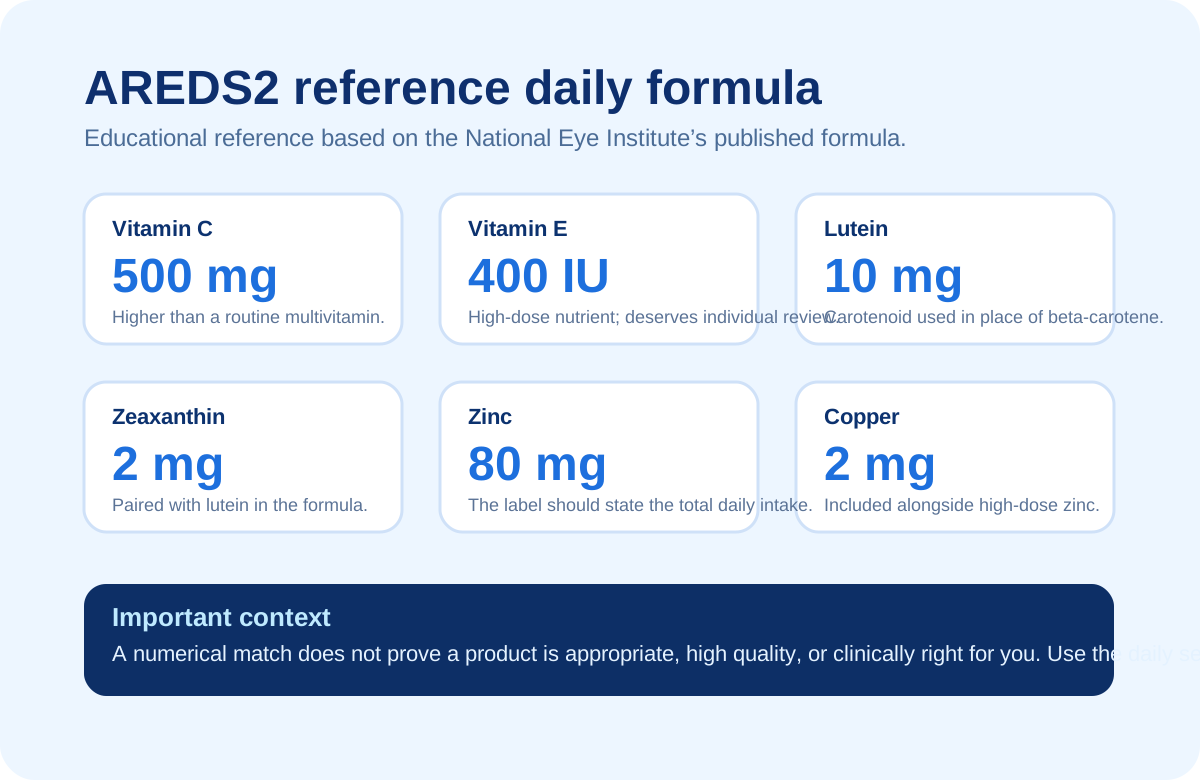
Per daily formula, the National Eye Institute lists vitamin C 500 mg; vitamin E 400 IU; lutein 10 mg; zeaxanthin 2 mg; zinc 80 mg; and copper 2 mg. A brand may use multiple pills to provide the daily amount, and product labels may not match the studied formula.
Who should ask about it?
People diagnosed with intermediate AMD and some people with late AMD in one eye should discuss AREDS2 with their eye-care clinician. The formulation does not prevent early AMD from becoming intermediate AMD, does not remove cataracts and does not reverse existing damage.
Why avoiding beta-carotene matters for some people
The earlier AREDS formula included beta-carotene. NEI guidance notes a lung cancer risk concern in smokers and former smokers and recommends AREDS2 instead. Do not assume that any bottle labeled “AREDS” uses the newer formula.
When a regular vitamin may make more sense
When the goal is a general dietary gap rather than treatment of a diagnosed AMD stage, the relevant question may be nutritional sufficiency and safety rather than a clinical high-dose formula. Avoid a product simply because the label displays more milligrams.
Use our guide to reading eye-vitamin labels and cost calculator to compare verified current products.
Decision guide: four different situations
| What you know today | Sensible next action | What not to do |
|---|---|---|
| An eye-care professional diagnosed intermediate AMD | Ask whether the studied AREDS2 formulation is appropriate and which daily serving to use | Replace the prescribed formula with an unrelated “eye health blend” |
| Late AMD in one eye | Ask whether AREDS2 may help reduce progression risk in the other eye | Expect supplements to restore the affected eye’s lost vision |
| Early AMD or no AMD diagnosis | Follow the eye clinician’s monitoring advice and maintain ordinary nutrition and risk-factor care | Assume the trial proved benefit for early AMD or every adult over 50 |
| New blurry vision, glare or difficulty driving at night | Arrange an examination to investigate the cause | Use the most strongly advertised formula as a self-diagnosis |
This distinction reflects the National Eye Institute’s guidance on who may benefit. Eligibility relates to disease stage, not an arbitrary age threshold or a marketing phrase such as “aging eyes.”
A six-point checklist for an AREDS2 product label
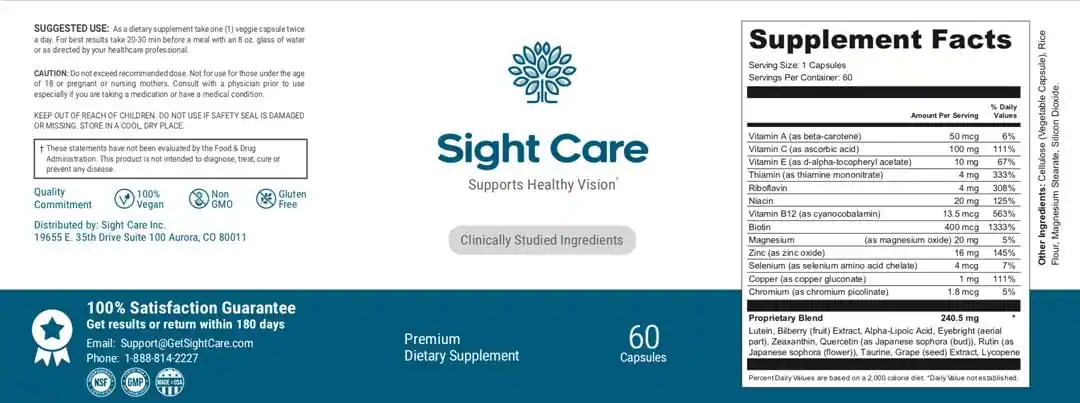
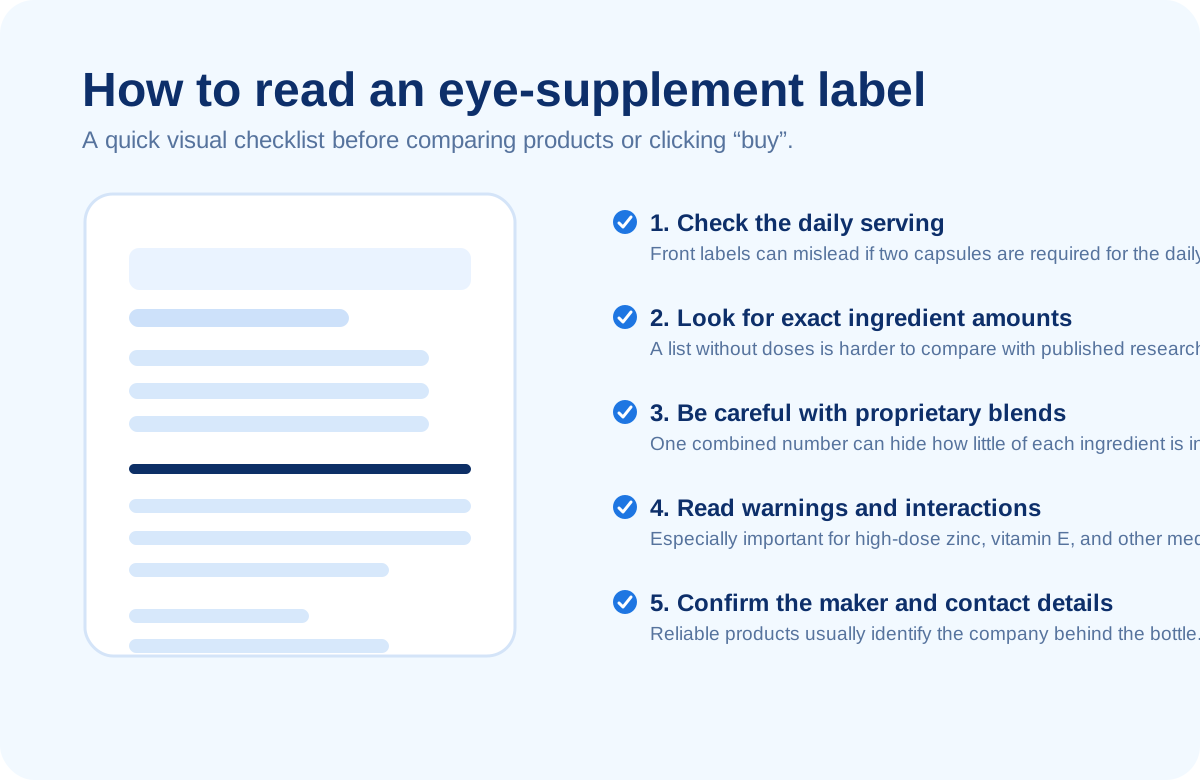
- Verify the manufacturer and access the current Supplement Facts panel, not only an advertisement or a third-party screenshot.
- Read the serving size. The research reference is stated per day; one or more capsules may make up that daily amount.
- Compare all six amounts with the NEI formula, not just lutein. Our label comparison tool can calculate numerical differences.
- Check for beta-carotene. It is absent from the newer AREDS2 research formula, a relevant distinction for current or former smokers.
- Discuss safety and medications. High-dose vitamin E and zinc are not trivial additions to a routine multivitamin. See our safety guide.
- Compare the cost of daily servings. Count the actual recommended number of pills per day and any shipping costs, rather than comparing bottle labels alone.
What a match cannot tell you: A perfect label match does not demonstrate ingredient purity, third-party testing, product authenticity or individual safety. Those remain separate questions.
Common misconceptions
“If AREDS2 contains lutein, any lutein supplement does the same thing.”
No. The studied formula combines lutein with zeaxanthin, two vitamins, zinc and copper. Research on one compound is not proof that an unrelated formula yields the same clinical outcome.
“Everyone over 60 should take AREDS2.”
No. The evidence concerns certain diagnosed AMD groups, not age alone. High-dose supplementation is not a substitute for a dilated eye examination.
“An AREDS2 label means the bottle can reverse cataracts or 20/20 vision.”
No. AREDS2 research does not establish those outcomes. Read our cataract evidence guide and 20/20 vision explainer.
Sources
- National Eye Institute — AREDS2 supplement information
- National Eye Institute — Major AREDS and AREDS2 study findings
Compare the exact daily label against the reference
For a product advertised as “AREDS2,” check amounts per recommended daily serving rather than per capsule. Try our AREDS2 label reference checker and read the separate safety and interaction guide. The comparison tool checks numbers only; it cannot verify manufacturing standards or tell you whether AREDS2 is medically appropriate.
This guide is based on published research and public health sources. We have not personally tested supplements or provided individualized medical advice. Read our evaluation process.
Check the evidence, then the label.
Use our label reference tool to compare stated daily amounts with the NEI AREDS2 study formula. A dose match does not establish suitability or product quality.